
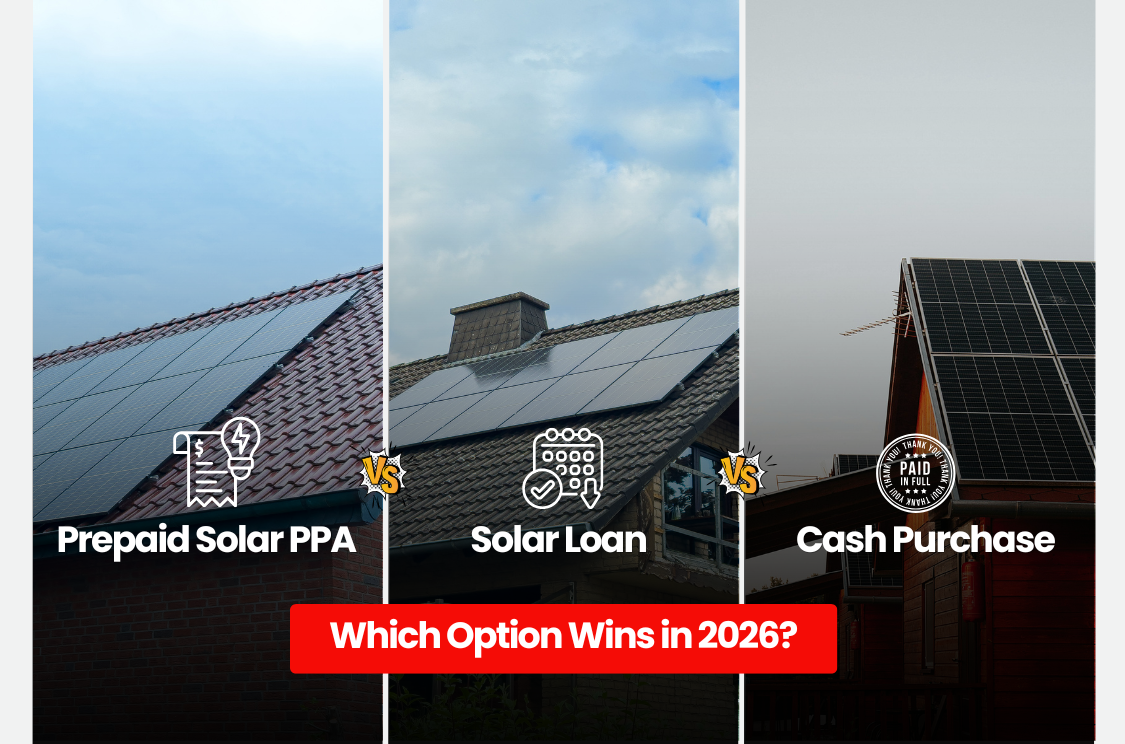
California homeowners evaluating solar energy systems in 2026 are facing a different financial landscape than in prior years. Changes in federal incentives, evolving utility rate structures, financing terms, and long-term electricity costs have increased the importance of understanding how solar financing structures work.
For many homeowners, the decision is no longer limited to choosing between a solar loan or cash purchase. Third-party ownership structures, including prepaid solar power purchase agreements (PPAs), are also part of the conversation.
Each financing structure involves different considerations related to ownership, maintenance responsibilities, upfront costs, payment obligations, contract duration, and eligibility for potential incentives.
This article provides general educational information about prepaid solar PPAs, solar loans, and cash purchases in California as of 2026.
What Changed in Solar Financing in 2026?
As of 2026, certain federal residential solar incentives that previously applied to some directly owned residential systems may no longer be available in the same form as prior years, depending on current federal law and applicable IRS guidance.
At the same time, some commercial clean energy incentive programs may still apply to certain third-party ownership structures, subject to eligibility requirements and regulatory compliance.
These changes have increased homeowner interest in understanding how financing structures may affect long-term economics, ownership timelines, and upfront costs.
In California utility territories served by providers such as entity[“company”,“Pacific Gas and Electric Company”,“California utility company”] and entity[“company”,“Southern California Edison”,“California utility company”], utility rate structures and time-of-use pricing may also influence how homeowners evaluate solar financing options.
Because regulations and incentive programs can change, homeowners should independently verify current policies before making financing decisions.
What Is a Prepaid Solar PPA?
A prepaid solar power purchase agreement (PPA) is a type of third-party ownership structure in which a provider installs and owns the solar energy system while the homeowner makes an upfront payment for some or all anticipated electricity usage under the agreement.
Under many prepaid PPA arrangements:
· The provider retains system ownership during the agreement period
· The provider may be responsible for certain maintenance or monitoring obligations
· The homeowner receives electricity generated by the system under contract terms
· Ownership transfer or purchase options may or may not exist depending on the agreement
Some third-party ownership providers may seek eligibility for certain commercial clean energy incentives where permitted by law. Any pricing impact or economic benefit associated with such incentives depends on multiple factors, including provider policies, market conditions, project eligibility, and applicable regulations.
Consumers should carefully review prepaid PPA agreements to understand:
· Contract duration
· Escalator provisions
· Maintenance responsibilities
· Transfer rights
· Early termination provisions
· Purchase options
· System removal obligations
Prepaid PPAs may be considered by homeowners seeking reduced monthly payment obligations or lower upfront commitments compared to certain ownership structures, although suitability varies by household and financial goals.
How Solar Loans Work
A solar loan is a financing arrangement in which the homeowner borrows funds to purchase a solar energy system and repays the loan over time according to the financing agreement.
Under many solar loan structures:
· The homeowner owns the system upon installation or financing close
· Monthly loan payments apply
· Interest charges and financing costs may apply
· The homeowner may be responsible for maintenance and system-related obligations unless otherwise specified
Potential economic outcomes associated with solar loans depend on:
· Interest rates
· Loan duration
· Utility rates
· System performance
· Energy consumption patterns
· Maintenance costs
· Regulatory conditions
Some homeowners may prefer solar loans because they allow direct ownership while spreading costs over time. Others may determine that monthly payment obligations or financing costs do not align with their financial goals.
Consumers should carefully evaluate loan disclosures, repayment terms, fees, dealer fees, APR calculations, prepayment provisions, and projected payment schedules before entering into financing agreements.
Cash Purchase Solar Systems
A cash purchase involves paying the full system purchase price upfront without third-party financing.
Under a cash purchase structure:
· The homeowner generally owns the system directly
· There are typically no ongoing loan payments
· The homeowner may assume responsibility for maintenance, repairs, and system oversight unless otherwise covered by warranty
Some homeowners prefer cash purchases because they avoid financing-related obligations and interest charges. However, upfront costs may be substantially higher compared to financing alternatives.
The long-term economic value of a cash purchase depends on many factors, including:
· Utility electricity costs
· System performance
· Maintenance expenses
· Equipment lifespan
· Property ownership duration
· Regulatory changes
Consumers should not assume that projected savings or production estimates are guaranteed.
General Comparison of Solar Financing Structures
| Consideration | Prepaid Solar PPA | Solar Loan | Cash Purchase |
| System Ownership During Initial Term | Typically provider-owned | Typically homeowner-owned | Homeowner-owned |
| Upfront Payment | Often partial or prepaid structure | Often lower upfront requirement | Highest upfront payment |
| Monthly Payment Obligation | Depends on agreement structure | Typically yes | Typically none |
| Maintenance Responsibilities | Varies by agreement | Often homeowner responsibility | Often homeowner responsibility |
| Contract Duration | Contract-based | Loan-term based | No financing term |
| Flexibility | Depends on contract | Depends on financing terms | Depends on ownership goals |
| Incentive Treatment | Depends on provider eligibility and law | Depends on applicable law | Depends on applicable law |
No single financing structure is universally better for all homeowners. Suitability depends on financial circumstances, ownership goals, expected homeownership duration, risk tolerance, and contract terms.
Example Scenario for Educational Purposes Only
The following example is hypothetical and provided solely for general educational purposes. It does not represent a guarantee of savings, system performance, or financial outcome.
A homeowner in entity[“city”,“Fremont”,“California, USA”] compares three solar financing options in 2026:
· A prepaid solar PPA
· A solar loan
· A direct cash purchase
The homeowner evaluates:
· Estimated upfront costs
· Expected monthly obligations
· Planned length of homeownership
· Maintenance responsibilities
· Utility electricity rates
· Contract flexibility
After reviewing the options, the homeowner determines that one structure aligns more closely with their personal financial preferences and long-term plans.
Another homeowner with different usage patterns, financial goals, or homeownership timelines could reasonably reach a different conclusion.
Who May Consider Each Financing Structure
Different financing structures may be appropriate for different homeowners.
Prepaid Solar PPAs
Some homeowners may consider prepaid PPAs if they:
· Prefer third-party maintenance structures
· Seek alternatives to traditional financing
· Want reduced monthly payment obligations
· Prefer not to directly own the system initially
Solar Loans
Some homeowners may consider solar loans if they:
· Prefer direct ownership
· Want to spread costs over time
· Are comfortable with financing obligations
· Plan to remain in the property long term
Cash Purchases
Some homeowners may consider cash purchases if they:
· Prefer immediate ownership
· Want to avoid financing costs
· Have available capital for upfront investment
· Prefer full control over the system
Consumers should independently evaluate whether any financing structure aligns with their financial circumstances and long-term goals.
Risks and Limitations
All solar financing structures involve risks and limitations.
Potential risks may include:
· Changes in utility rate structures
· Policy or regulatory changes
· Financing costs
· Equipment failure or degradation
· Maintenance expenses
· Transfer complications during home sale
· Contract restrictions
· Variability in energy production
· Delays in installation or interconnection
Consumers should carefully review all agreements and disclosures before signing contracts.
Policy and Regulatory Considerations
Solar financing and incentive programs are influenced by evolving federal, state, and utility regulations.
Policies administered by agencies such as the entity[“organization”,“California Public Utilities Commission”,“California state regulatory agency”] and applicable federal agencies may affect:
· Net billing structures
· Utility compensation methodologies
· Interconnection rules
· Incentive availability
· Financing economics
Regulatory conditions may change over time, and future changes could materially affect projected economic outcomes.
Frequently Asked Questions
Is a prepaid solar PPA better than a solar loan?
No financing structure is universally better for all homeowners. Different structures may offer different advantages and trade-offs depending on ownership goals, financial circumstances, contract terms, and energy usage patterns.
Can homeowners still qualify for solar incentives in California in 2026?
Incentive availability depends on current laws, utility programs, tax status, project structure, and other eligibility requirements. Consumers should consult qualified tax professionals regarding current eligibility.
Is a cash purchase always the lowest-cost option?
Not necessarily. Long-term economics depend on financing costs, maintenance expenses, utility rates, system performance, and other variables.
What is the most important factor when choosing a solar financing structure?
Important considerations may include contract terms, ownership goals, financial flexibility, expected homeownership duration, and risk tolerance.
Conclusion
Solar financing decisions involve multiple considerations, including ownership preferences, upfront costs, financing obligations, contract terms, maintenance responsibilities, utility rates, and potential regulatory changes.
Prepaid solar PPAs, solar loans, and cash purchases each involve different trade-offs and may be suitable for different homeowners depending on individual circumstances.
Nabu Energy provides general educational information regarding solar financing structures available in California. Nabu Energy does not provide legal, tax, accounting, or investment advice.
Consumers should independently evaluate all financing terms and consult qualified legal, tax, and financial professionals before entering into any solar financing agreement.
California Consumer Notice
Consumers are encouraged to request and review all required California disclosures related to financing, contractor licensing, warranties, cancellation rights, and system performance representations.
Contractor Verification
Consumers should verify contractor licensing status through the entity[“organization”,“California Contractors State License Board”,“California contractor licensing agency”] before entering into installation agreements.
No Earnings or Investment Representation
Solar systems are not investment products, and this article does not represent or guarantee any rate of return, home value increase, energy savings amount, or financial performance outcome.
Forward-Looking Statements Safe Harbor
Certain statements in this article may contain forward-looking information regarding utility rates, incentive programs, financing structures, or projected economic considerations. Actual results may differ materially due to changes in law, market conditions, utility policies, technology performance, financing availability, or other factors outside of Nabu Energy’s control.