IMPORTANT LEGAL NOTICES – READ BEFORE PROCEEDING
What Is a Level 2 EV Charger?
A Level 2 EV charger is a higher-voltage electric vehicle charging system designed to charge EV batteries faster than a standard household outlet. Most Level 2 chargers operate on a 240-volt electrical circuit, similar to the type commonly used for large home appliances such as dryers or ovens.
Unlike Level 1 charging, which typically plugs into a standard 120-volt outlet, a Level 2 charger can deliver more charging power over a shorter period. Charging speed varies based on vehicle compatibility, charger amperage, battery condition, and electrical system capacity. As a general reference, many Level 2 chargers may add approximately 20 to 30 miles of estimated range per hour of charging under certain conditions, though actual results will vary depending on the specific vehicle, charger model, battery state, ambient temperature, and other factors.
Level 2 chargers are available in hardwired (permanently wired) and cord-and-plug configurations. Hardwired units are permanently connected to a home’s electrical system. Cord-and-plug models connect to a compatible 240-volt receptacle, such as a NEMA 14-50 outlet. Each configuration carries different installation requirements, code implications, and may suit different household needs. A licensed electrician must evaluate which configuration is appropriate for a specific installation location and panel setup.
Informational Note – Code Context: Under NEC Article 625 as incorporated into the applicable edition of the California Electrical Code, electric vehicle supply equipment (EVSE) is generally required to be listed and labeled by a nationally recognized testing laboratory (NRTL). All EVSE must have a sufficient rating to supply the load it serves. EV charging loads are classified as continuous loads, which affects how circuits and service capacity must be sized. These are general descriptions only. Readers must verify applicable requirements with a licensed electrician and the local AHJ. See Legal Notices 2, 6, and 9 above.
Why Bay Area Homeowners Are Exploring Home EV Charging
The Bay Area is among the regions with higher-than-average gasoline prices in California, and electricity costs and availability vary by utility provider and rate plan. For EV owners who currently rely on public charging networks, home charging may reduce dependence on shared infrastructure, particularly during peak demand periods when public stations can experience congestion.
Homeowners in cities such as San Jose, Fremont, Oakland, and Palo Alto may also benefit from relatively mild year-round temperatures, which can support more consistent EV battery performance compared to regions with extreme seasonal weather. However, electricity rates in PG&E and other local utility service territories can be significant, and homeowners should review available rate schedules – including time-of-use (TOU) plans that may offer lower rates during off-peak overnight hours – before assuming home charging will reduce overall energy costs.
Home charging may not be a viable option for all Bay Area residents. Those living in apartments, condominiums, or rental properties may face restrictions related to electrical access, landlord approval, homeowners association (HOA) rules, CC&R provisions, or shared parking arrangements that limit the feasibility of a dedicated home charging installation. Renters and condo owners should review their lease, HOA governing documents, and CC&Rs and obtain all required approvals before proceeding.
Safe Harbor – Utility Information: References to utility programs, TOU rate plans, and electricity pricing in this article are illustrative and general in nature. Rate structures, program terms, eligibility requirements, and availability are subject to change by the utility at any time and without notice. Nabu Energy makes no representation that any rate plan or program referenced herein is currently available, applicable to any reader’s circumstances, or will produce any specific cost outcome. Contact your utility provider directly for current and binding rate plan information. See Legal Notices 2 and 3 above.
Governing Codes for Residential EV Charger Installations in California
Understanding which electrical codes apply is an important first step for any Bay Area homeowner considering a Level 2 charger installation. The following is a general educational summary only and does not constitute a legal interpretation of any code provision.
California Electrical Code (CEC) – Currently Applicable
As of January 1, 2026, California’s residential electrical work is governed by the 2025 California Electrical Code (CEC), which is based on NEC 2023 with California-specific amendments. The CEC is adopted through the California Building Standards Commission and administered through Title 24, Part 3. Individual Bay Area jurisdictions – including San Jose, Fremont, Oakland, and Palo Alto – may adopt additional local amendments beyond the statewide CEC. Always verify the locally adopted code edition and any local amendments with the specific municipal building department before commencing work.
For EV charger installations, the CEC incorporates Article 625, which governs electric vehicle power transfer systems and supply equipment. Key concepts under the currently applicable code edition include the following general principles, described here for educational purposes only:
- Listed Equipment: All EVSE installed for residential use must be listed and labeled by a nationally recognized testing laboratory. Equipment without a valid listing mark may not be used in a permitted installation.
- Continuous Load Sizing: EV charging loads are classified as continuous loads. Circuits must generally be sized at 125% of the maximum EV charging load. For example, a 32-amp Level 2 charger typically requires a dedicated 40-amp circuit (32A × 125% = 40A). Circuit conductors and overcurrent protection devices must be sized accordingly under the applicable CEC provisions.
- GFCI Protection: Receptacles installed for connection to EV supply equipment must be GFCI protected. Installations in wet or outdoor locations require weatherproof enclosures with appropriate ratings.
- Disconnect Requirements: EV supply equipment rated over 60 amperes or operating at over 150 volts to ground must have a readily accessible disconnect capable of being locked in the open position.
- Ventilation: Article 625 includes provisions addressing ventilation for enclosed indoor charging locations, including residential garages.
Safe Harbor – Code Accuracy
The code provisions described above are summarized for general educational purposes only. They do not constitute a complete or exhaustive statement of all applicable requirements. Electrical code compliance requires a full project-specific analysis by a licensed electrician. Code provisions may have been amended, superseded, or modified at the local level. Nabu Energy makes no warranty that any code summary in this article is accurate, complete, or currently applicable to any specific project. The AHJ has final authority over code compliance determinations. See Legal Notices 2, 6, and 9 above.
CalGreen (California Green Building Standards Code) – New Construction
For new single-family construction permitted on or after January 1, 2026, the 2025 CalGreen Code (Title 24, Part 11) generally requires that each dwelling unit include a raceway of not less than trade size 1 (nominal 1-inch inside diameter) originating at the main service or subpanel and terminating at the proposed EV charger location. The electrical panel must include capacity and a permanently labeled reserved space for a future 40-ampere, 208/240-volt dedicated branch circuit labeled “EV CAPABLE.” These provisions apply to new construction and do not retroactively apply to existing homes. Applicable CalGreen provisions for a specific project must be confirmed with the local building department.
NEC 2026 – Not Currently in Effect in California
The 2026 edition of the National Electrical Code was approved by the NFPA on June 20, 2025, and published on August 20, 2025. It contains significant Article 625 updates. NEC 2026 does not currently apply in California and is not expected to be incorporated until the 2028 CEC cycle, with an anticipated effective date of January 1, 2029. Projects underway in California today must comply with the 2025 CEC. Projects planned for later years should re-verify the applicable code edition at the time of permit application.
Safe Harbor – Jurisdiction and Code Edition: Code adoption timelines referenced in this article are based on information available as of the publication date and are subject to change. Nabu Energy makes no warranty that any jurisdiction will adopt or not adopt any particular code edition on any anticipated schedule. Always verify the currently adopted code with the local AHJ before making any project decisions. See Legal Notices 2, 6, and 11 above.
Key Factors to Evaluate Before Installing a Level 2 Charger
Before proceeding with a Level 2 charger installation, homeowners should assess several variables with the assistance of qualified professionals. The following is a general educational overview of factors to discuss with a licensed electrician, attorney, insurance professional, and tax advisor.
Electrical Panel Capacity and Load Calculations
A Level 2 charger installation requires a dedicated 240-volt circuit. Because EV charging loads are classified as continuous loads under Article 625, the circuit must generally be sized at 125% of the charger’s rated amperage. A licensed electrician performs a residential load calculation – typically using the Optional Method under the applicable CEC equivalent of NEC Section 220.82 – to determine whether the existing panel can accommodate the new circuit without a service upgrade.
If available panel capacity is insufficient, a service upgrade may be required, which can add considerably to the overall project cost. Homeowners should request a professional load calculation and panel assessment before purchasing a charger unit, as panel limitations may significantly affect which charger models and circuit amperages are feasible.
Safe Harbor – Electrical Assessments: Information about load calculations and panel requirements in this article is general in nature. Every home has different electrical characteristics. A description in this article of what is “typically” required does not mean it will be required or sufficient in any specific installation. Only a licensed electrician inspecting the actual premises can determine what is needed. See Legal Notices 2, 3, and 9 above.
EVSE Listing and Equipment Selection
All EVSE used in a permitted installation must bear a listing mark from a nationally recognized testing laboratory (NRTL), such as UL or ETL. Homeowners should verify that any charger unit they are considering carries an appropriate listing mark before purchase, as unlisted equipment may not be accepted in a permitted installation. The installed charger must also be rated to supply the load it serves.
GFCI Protection and Weatherproofing
All receptacles used for EV charging must have GFCI protection. For installations in garages, exterior walls, carports, driveways, or other locations subject to moisture or weather exposure, weatherproof enclosures with appropriate ratings are required. The electrician will determine the appropriate GFCI device type and enclosure rating for the specific installation.
Disconnect Requirements
If the charger draws more than 60 amperes or operates at over 150 volts to ground, a readily accessible lockable disconnect is required. The installing electrician will determine whether the circuit breaker in the panel serves as the required disconnect or whether a separate disconnect device must be installed at or near the charger location.
Local Permitting Requirements
Most Bay Area jurisdictions require building permits for Level 2 EV charger installations and associated electrical work. California law requires municipalities above 250,000 in population to process complete EV charger permit applications on an expedited basis, but timelines, fees, and procedural requirements vary by jurisdiction. Working with a licensed electrical contractor familiar with local permitting is advisable.
Safe Harbor – Permitting: Permitting requirements described in this article are general and informational only. Permit requirements, fees, and processing timelines are set by individual jurisdictions and are subject to change. Failure to obtain required permits may result in code enforcement action, fines, required removal of equipment, voided homeowner’s insurance, and mandatory disclosure obligations in any future real estate transaction. Nabu Energy makes no representation that any described permitting process is complete, current, or applicable to any specific project. Contact the relevant building department for authoritative and current permit requirements. See Legal Notices 2, 5, and 9 above.
Contractor Licensing – California C-10 Requirement
California requires that residential electrical work, including EV charger installations, be performed by a contractor holding a valid C-10 Electrical Contractor license issued by the CSLB. Homeowners may also pull an Owner-Builder permit for work on their primary residence, subject to limitations, but doing so means assuming full responsibility for code compliance, inspection coordination, and all associated liability – including potential real estate disclosure obligations. For most homeowners, engaging a licensed C-10 contractor is the appropriate course of action.
Homeowners should verify any contractor’s C-10 license status at cslb.ca.gov before engaging them, and confirm the contractor carries active general liability insurance and workers’ compensation coverage. Under California Business and Professions Code § 7115, contractors must disclose their general liability insurance status in writing. Homeowners should request a Certificate of Insurance and consider requiring the contractor to name them as an additional insured on the contractor’s general liability policy.
Safe Harbor – Contractor Information: Guidance about contractor qualifications in this article is for general informational purposes only. It does not constitute legal advice, a contractor referral, or an endorsement of any specific contractor or business. Nabu Energy is not a licensed contractor and has no affiliation with any contracting company. Homeowners bear sole responsibility for independently vetting, hiring, and supervising any contractor engaged for their project. Nabu Energy shall have no liability for the acts or omissions of any contractor a reader may engage. See Legal Notices 3, 7, and 13 above.
Utility Rate Schedules and Time-of-Use Plans
PG&E and other Bay Area utilities may offer time-of-use (TOU) rate plans that charge different electricity rates depending on the time of day. Charging an EV during off-peak hours – typically late evening to early morning – may result in lower per-kilowatt-hour costs compared to peak periods, though outcomes vary by household and plan. Homeowners should contact their utility provider directly for current and binding rate plan information before making financial decisions based on anticipated charging costs.
Safe Harbor- Utility Rates: No statement in this article constitutes a guarantee, projection, or estimate of actual electricity costs for any specific household. Energy costs depend on numerous household-specific factors beyond the scope of this article. Information about utility rates and programs may be outdated. Contact your utility provider for current information. See Legal Notices 2, 3, and 11 above.
Vehicle Compatibility
Not all electric vehicles charge at the same rate when connected to a Level 2 charger. Each EV has an onboard charger with a maximum acceptance rate independent of the EVSE’s rated output. Homeowners should review their vehicle manufacturer’s current specifications before selecting a charger model or circuit amperage.
Homeowners Association (HOA) and CC&R Restrictions
Homeowners in communities governed by a homeowners association or CC&Rs should review all governing documents and obtain any required HOA approvals before commencing a Level 2 charger installation. California Civil Code § 4745 provides certain protections for EV charging installations in HOA communities, but restrictions and approval processes vary. Consulting a California-licensed attorney familiar with HOA law is advisable before proceeding.
Safe Harbor – HOA and CC&R: This article does not constitute legal advice regarding HOA rights or CC&R interpretation. California law in this area may have changed since this article was published. Consult a licensed California attorney for advice specific to your governing documents and situation. See Legal Notices 1 and 13 above.
Overview of the Installation Process
The following is a general educational description of a typical installation process. Actual steps, sequence, requirements, and costs will vary by project, jurisdiction, and AHJ requirements. This description is not a substitute for project-specific guidance from a licensed electrician and the local building department.
Site Assessment and Load Calculation: A licensed C-10 electrician evaluates the home’s electrical panel, performs a load calculation under the applicable CEC provisions, and assesses the proposed installation location.
Equipment Selection: Homeowners, in consultation with the electrician, select a listed EVSE with an appropriate amperage rating based on vehicle compatibility, panel capacity, and AHJ acceptance.
Permit Application: The licensed contractor or the homeowner (under an Owner-Builder permit) submits a permit application to the local building department, including circuit diagrams, load calculation documentation, and EVSE listing information.
Electrical Work: The electrician installs a dedicated 240-volt circuit sized at 125% of the charger’s rated continuous load, runs conductors through appropriate conduit, installs the required GFCI protection, and performs any necessary panel work. Outdoor or wet-location installations require weatherproof enclosures.
Charger Mounting: The listed EVSE is mounted and secured per manufacturer instructions and applicable Article 625 requirements.
Inspection: The local building department inspects the completed installation before energizing the circuit for regular use.
Safe Harbor – Process Description: The installation process described above is a general overview only and does not represent all steps, requirements, or contingencies that may arise in any specific project. Local AHJ requirements may differ. Only the licensed electrician and the local building department can determine what is required for a specific installation. See Legal Notices 2, 9, and 13 above.
Potential Costs to Anticipate
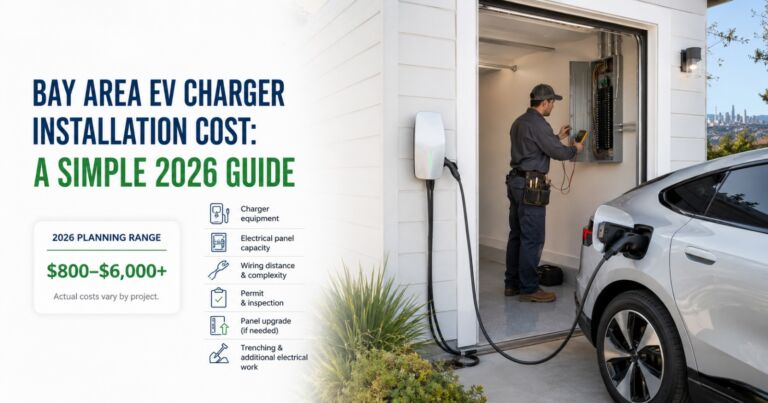
The total cost of a Level 2 EV charger installation in the Bay Area varies widely based on home electrical condition, the EVSE model selected, circuit run complexity, local labor rates, and whether panel upgrades are required. General cost categories may include the EVSE unit itself, electrical installation labor, panel service upgrades if applicable, GFCI devices and weatherproofing materials, and permit fees.
Safe Harbor – Cost Information: Nabu Energy does not publish specific cost estimates in this article because costs are highly project-specific, vary by contractor, and change over time. No cost range or figure referenced in this article, or on any page linking to this article, should be relied upon as an estimate for any specific project. Obtain multiple written, itemized estimates from licensed C-10 contractors for your specific installation before making any financial commitment. Nabu Energy shall have no liability for any financial decisions made based on cost information in this article. See Legal Notices 2, 3, and 11 above.
Incentives and Rebates That May Be Available
Several programs may help offset installation costs for eligible homeowners. Program availability, eligibility, income requirements, funding levels, and application deadlines are subject to change at any time.
Federal Tax Provisions: Federal tax provisions related to alternative fuel vehicle refueling property, including EVSE, have historically been available to certain qualifying homeowners under the U.S. Internal Revenue Code. Applicable provisions, credit amounts, phase-out thresholds, qualifying equipment requirements, and income limitations change with legislation. Consult a qualified tax professional – not this article – to determine what federal tax provisions, if any, are currently available and applicable to your specific tax situation. The Section 25D residential clean energy credit that applied to EV charging equipment in prior years has been subject to legislative changes; do not assume any prior credit description reflects current law.
California and Utility Programs: Some California utilities, including PG&E, have periodically offered rebates or incentives for residential EV charger installations. Program availability and funding levels are limited and change without notice. Contact your utility provider directly for current program information.
Bay Area Air Quality Management District (BAAQMD): The BAAQMD has offered programs related to clean vehicle adoption and EV infrastructure. Homeowners should verify current BAAQMD program availability directly through official BAAQMD communications.
Safe Harbor – Incentives and Tax Programs: Nabu Energy makes no representation that any incentive, rebate, or tax credit described in this article is currently available, funded, applicable to any specific reader, or will be available at the time of any specific installation. Program descriptions in this article may be outdated. Nabu Energy is not a tax advisor. No content in this article constitutes tax advice. Do not make installation decisions based on anticipated incentives without first confirming current availability and eligibility with the relevant administering agency and a qualified tax professional. Nabu Energy shall have no liability for any financial decisions made in reliance on incentive or tax information in this article. See Legal Notices 1, 2, 3, 10, and 11 above.
Is a Level 2 Home Charger the Right Choice?
A Level 2 home EV charger may be a practical option for Bay Area homeowners who own or lease an electric vehicle, have a dedicated parking space with appropriate electrical access, and have confirmed with a licensed electrician that the installation is technically and code-compliant. The ability to charge overnight on a predictable schedule may reduce reliance on public charging infrastructure and may simplify daily charging routines for some households.
However, home charging is not appropriate for every situation. Homeowners in older properties with limited electrical capacity, those in multi-unit housing without individual electrical access, renters without landlord approval, condo owners without HOA approval, and households that drive infrequently may find that installation costs do not justify the convenience benefit. An assessment by a licensed electrician, combined with a review of current utility rates and available incentives, provides the most accurate picture of feasibility for a specific household.
Safe Harbor – Suitability Assessment: No statement in this article constitutes a recommendation that any specific homeowner should or should not install a Level 2 EV charger. Suitability determinations are inherently individual and fact-specific. Nabu Energy makes no representation that a home EV charger is appropriate for any reader’s specific circumstances, financial situation, or property. See Legal Notices 1, 2, and 13 above.
Finding a Qualified Installer in the Bay Area
California requires residential electrical work to be performed by a C-10 licensed electrical contractor. When evaluating contractors, homeowners may wish to:
- Verify C-10 license status at cslb.ca.gov before engaging any contractor.
- Request a written, itemized estimate covering all labor, materials, permit fees, panel work, and GFCI devices.
- Ask the contractor to confirm they will obtain all required permits and coordinate inspections.
- Request a Certificate of Insurance confirming active general liability and workers’ compensation coverage.
- Ask whether the homeowner will be named as an additional insured on the contractor’s general liability policy for the duration of the project.
- Request references from prior EV charger installations in the relevant Bay Area jurisdiction
Safe Harbor – Contractor Guidance: The checklist above is provided for general informational purposes only and does not constitute legal advice on contractor engagement, contract requirements, or liability. California Business and Professions Code § 7159 imposes specific written contract requirements on home improvement contractors; homeowners should ensure any contract they sign complies with applicable requirements. Nabu Energy has no affiliation with, and makes no endorsement of, any contractor.
Nabu Energy shall have no liability for the quality, safety, or code compliance of any work performed by any contractor a reader may engage. Readers are advised to consult a licensed California attorney before executing any significant home improvement contract. See Legal Notices 1, 3, 7, and 13 above.
Summary
Installing a Level 2 EV charger at home is one way Bay Area residents may improve residential charging convenience and reduce dependence on public charging networks. Installations in California are currently governed by the 2025 California Electrical Code (CEC) (NEC 2023-based, effective January 1, 2026), along with applicable CalGreen provisions and local amendments. NEC 2026 does not currently apply in California and is not expected to be incorporated until the 2028 CEC cycle.
Key technical concepts under applicable code include: listed and labeled EVSE, dedicated circuit sizing at 125% of the continuous EV charging load, GFCI protection for all EV charging receptacles, weatherproof enclosures for outdoor or wet locations, and lockable disconnects for higher-amperage equipment. All installations require permits from the local building department and must be performed by a C-10 licensed electrical contractor.
Homeowners are encouraged to consult a licensed electrician for a panel assessment, contact their local AHJ for current permit requirements, speak with their utility provider about current rate plans, and consult a qualified tax professional and insurance advisor before making installation decisions.
Final Legal Notice
This article was prepared by Nabu Energy and reflects general educational information as of the date noted at the top of this document. It does not constitute electrical, legal, tax, financial, insurance, real estate, or contracting advice of any kind. All legal notices set out at the beginning of this article, including the limitation of liability, warranty disclaimer, and no-endorsement provisions, apply in full to the entire contents of this article, including this summary section. Nabu Energy reserves the right to update, modify, or remove this article at any time without notice.
If you are unsure whether a Level 2 EV charger installation is appropriate for your property, consult a licensed C-10 electrical contractor before taking any action.
© Nabu Energy. All rights reserved. Reproduction of this article in whole or in part without prior written permission from Nabu is prohibited.