Estimated Reading Time: 12-minute read
Last Reviewed: August 2026
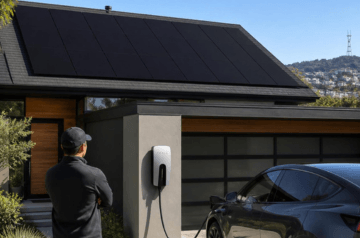
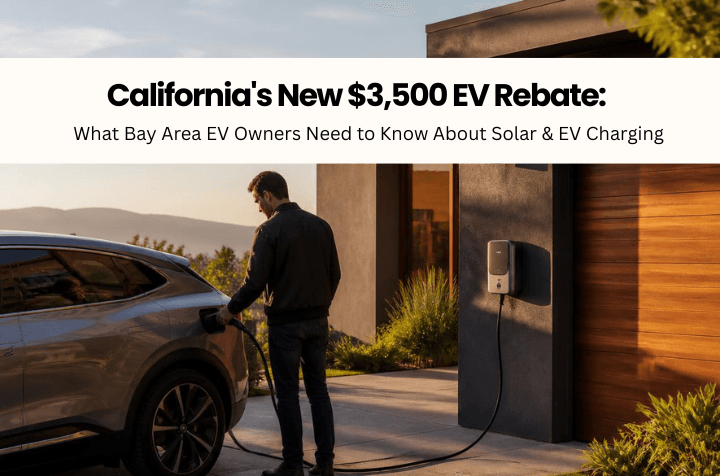
California’s new EV rebate, through the MyFirstEV program, is designed to make qualifying zero-emission vehicles more accessible to first-time buyers. The program offers up to $3,500 toward an eligible new zero-emission vehicle, while qualifying used vehicles can receive a separate incentive of up to $1,750. For Bay Area homeowners considering an EV, however, the vehicle purchase is only one part of the decision. Home charging, electrical capacity, solar generation, and battery storage can all influence how practical an EV is to own over the long term.
This guide explains what the new California EV incentive means for Bay Area drivers, who may qualify, how the rebate is expected to work, and what homeowners should consider when planning an EV charging setup. It also explains how home EV charging can fit into a broader residential solar and battery strategy.
Table of Contents
What Is the MyFirstEV Incentive?
California’s MyFirstEV program is intended to help first-time zero-emission vehicle buyers reduce the upfront cost of purchasing or leasing an eligible vehicle. The program was announced as part of California’s effort to continue expanding zero-emission vehicle adoption while making EV ownership more accessible to households that have not previously owned a qualifying ZEV.
For eligible new vehicles, the incentive can provide up to $3,500, subject to the program’s eligibility requirements and vehicle price limits. A separate incentive of up to $1,750 is available for qualifying used ZEVs purchased through participating manufacturer pre-owned programs.
The distinction is important because this is not a general $3,500 credit for anything related to EV ownership. The incentive is tied to the purchase or lease of a qualifying vehicle. It does not automatically pay for a home EV charger, electrical panel upgrade, solar panels, or battery storage.
For Bay Area homeowners, that distinction matters when calculating the overall cost of transitioning to an EV.
Why the New EV Incentive Matters for Bay Area Drivers
Electric vehicles are already a major part of California’s transportation market, and the Bay Area is one of the regions where EV ownership has become particularly visible. Drivers regularly travel throughout Silicon Valley and the wider Bay Area for work, commuting, and everyday activities.
California reported 86,857 new zero-emission vehicle sales in the second quarter of 2026, representing 19.1% of new vehicle sales statewide. Continued adoption means more homeowners are also thinking about what happens after the vehicle leaves the dealership: where it will be charged, how quickly it can charge, and whether the home’s electrical system can support the additional load.
For homeowners with a garage or dedicated parking space, home charging can be one of the biggest advantages of EV ownership. Instead of making a separate trip to a public charging station, drivers can plug in when they arrive home and charge while the vehicle is parked.
That also creates a natural connection between EV ownership and residential energy planning.
Is the $3,500 first-time ZEV Rebate Available to Everyone?
No. The MyFirstEV program is designed specifically for first-time zero-emission vehicle buyers, so simply purchasing an EV does not automatically make someone eligible.
Eligibility depends on the program’s requirements, including factors related to the buyer, the vehicle, and the transaction. The program is being administered through California’s clean transportation framework, with the California Air Resources Board overseeing implementation.
Because the program is new and implementation details are being finalized, prospective buyers should verify the current eligibility requirements before signing a purchase or lease agreement.
This is especially important for Bay Area buyers comparing several vehicles. A vehicle that appears affordable at first glance may not qualify if it exceeds the program’s applicable price limit or fails to meet other requirements.
Important: Nabu Energy does not administer the MyFirstEV program or determine eligibility. Incentive amounts, vehicle eligibility, program requirements, and funding availability are subject to current program rules. Verify eligibility directly with the program or participating dealer before purchasing or leasing a vehicle.
What Is the Vehicle Price Limit?
The announced program establishes different price limits for new and used qualifying vehicles.
For a new qualifying ZEV, the vehicle must have an MSRP of $50,000 or less.
For a used qualifying ZEV, the vehicle must be sold for $25,000 or less through an eligible participating manufacturer’s pre-owned program.
These limits make the incentive particularly relevant to buyers comparing vehicles in the mainstream EV market rather than exclusively considering higher-priced models.
However, the vehicle price is only one part of the ownership equation.
A buyer should also consider insurance, registration, electricity costs, charging equipment, possible electrical upgrades, and expected driving requirements when evaluating the long-term cost of an EV.
How Does the MyFirstEV Rebate Work?
The program is designed to make the incentive available during the vehicle transaction rather than requiring buyers to wait for a traditional tax filing process.
Participating manufacturers and dealerships are expected to play an important role in providing the incentive to eligible buyers. This could make the benefit more straightforward for consumers because the rebate can be incorporated into the vehicle purchase or lease process.
However, because implementation details can change as the program launches, buyers should confirm the exact process with the participating dealership and review the latest California program requirements before completing the transaction.
The safest approach is to treat the advertised $3,500 amount as “up to $3,500 for qualifying first-time ZEV buyers”, rather than assuming every first-time EV purchase will automatically receive the full amount.
What the Up to $3,500 MyFirstEV Incentive Covers
The most important thing for homeowners to understand is that the vehicle incentive and home-energy upgrades are separate considerations.
| Expense | Covered by MyFirstEV? |
| Qualifying new ZEV | Yes, subject to eligibility |
| Qualifying used ZEV | Yes, subject to eligibility |
| Home Level 2 EV charger | Not automatically covered |
| Electrical panel upgrade | Not automatically covered |
| Residential solar panels | Not automatically covered |
| Battery storage | Not automatically covered |
| EV charging installation | Not automatically covered |
This distinction prevents a common misunderstanding: receiving the vehicle rebate does not mean a homeowner has also received a rebate for installing an EV charger or solar system.
Those improvements should instead be evaluated separately based on the home’s electrical infrastructure, energy usage, driving habits, and long-term plans.
What Should Bay Area Homeowners Consider After Buying an EV?
For someone purchasing their first EV, the next question is often surprisingly simple:
“Where am I going to charge it?”
If the homeowner has reliable access to overnight charging at home, an EV can be significantly easier to incorporate into a daily routine. A Level 2 charger can provide substantially faster charging than a standard household outlet, making it practical for many daily commuters to recharge while the vehicle is parked overnight.
But before installing a Level 2 charger, homeowners should understand their existing electrical capacity.
Older homes may have smaller electrical services or panels with limited capacity for additional high-load equipment. A professional electrical evaluation can help determine whether the existing system can support the planned charger and whether other future loads should be considered at the same time.
This becomes particularly relevant for homeowners who are also considering solar panels, battery storage, heat pumps, induction cooking, or a second EV.
The Bigger Opportunity: Planning EV Charging With Solar
An EV doesn’t have to be viewed as an isolated purchase.
For homeowners who already have solar or are considering installing solar, the vehicle can become part of a broader home energy strategy.
Solar panels generate electricity during daylight hours, while many EV owners charge their vehicles overnight. Depending on the home’s energy usage, utility rate structure, solar system design, and charging schedule, homeowners may need to think carefully about how EV charging fits into their overall electricity consumption.
Battery storage can provide another layer of flexibility by storing electricity for later use. However, the economics and technical design depend on the individual property and should not be assumed to be the same for every homeowner.
The goal is not simply to install every available energy technology. The better approach is to understand the home’s current electrical capacity and future energy needs before deciding which upgrades make sense.
⭐⭐⭐⭐⭐ Honest Guidance for Home Energy Planning
“Very happy with their service. Just got installed new RAC 430w panels, Tesla PV3, PG&E switch done too. Got everything done at a very reasonable price.”
– Verified Bay Area, Homeowner
Do You Need a Level 2 Home EV Charger?
For many Bay Area EV owners, the biggest change after purchasing an electric vehicle is getting used to a new charging routine. If you have a dedicated parking space at home, charging overnight can be much more convenient than relying exclusively on public charging stations.
A standard household outlet can charge an EV, but it is generally much slower than a dedicated Level 2 charger. Level 2 equipment uses a 240-volt circuit and can provide substantially more charging power, making it a practical choice for drivers who use their vehicle every day.
The right charger, however, depends on more than the vehicle itself. Your home’s electrical service, existing electrical loads, parking location, available circuit capacity, and plans should all be considered before installation.
For example, a homeowner who is purchasing an EV today but plans to add a second EV, heat pump, induction range, solar panels, or battery storage may need a different electrical strategy than someone who only needs to charge one vehicle.
How Much Does a Level 2 Charger Matter for Daily Driving?
The value of Level 2 charging becomes particularly clear for commuters.
Imagine returning home after driving around the Bay Area during the day. Instead of planning a separate trip to a public charging station, you can plug the vehicle in when you arrive and allow it to charge while you’re sleeping.
The following morning, the vehicle is ready for another commute.
This doesn’t mean every EV owner needs a Level 2 charger. Drivers with short daily commutes and access to workplace or public charging may be perfectly comfortable without one. But for homeowners who drive frequently and have suitable parking, home charging can simplify EV ownership considerably.
Can Your Electrical Panel Support an EV Charger?
Before installing a home EV charger, one of the most important questions is whether your existing electrical system has sufficient capacity.
A Level 2 charger represents an additional electrical load that operates for an extended period. Your electrician needs to consider the home’s existing loads rather than looking at the charger in isolation.
An older electrical panel may already be supporting appliances such as an air conditioner, electric water heater, electric range, clothes dryer, pool equipment, or other high-demand equipment. Adding an EV charger without properly evaluating the existing system can create an electrical capacity problem.
A professional assessment can help determine whether your current panel can support the charger safely and whether an electrical upgrade should be considered.
What If Your Panel Needs an Upgrade?
A panel upgrade isn’t necessarily required simply because you purchased an EV.
The answer depends on the home’s electrical service, existing loads, available capacity, and the charging equipment being considered.
In some homes, the existing system may have sufficient capacity for a Level 2 charger. In others, an electrician may recommend a load-management solution, a different charging configuration, or an electrical panel or service upgrade.
This is why homeowners should avoid assuming that a particular charger will work simply because it works in another home.
Why EV Charging Should Be Considered Alongside Solar
If you’re purchasing an EV and already have solar, or you’re considering solar in the future, it’s worth evaluating both systems together.
An EV can significantly increase household electricity consumption. That doesn’t automatically mean adding more solar is the right answer, but it does mean your future electricity needs should be considered when evaluating a solar system.
For example, a homeowner who currently designs a solar system around existing household consumption may later purchase an EV. The home’s electricity demand could then change significantly.
Conversely, someone who is purchasing an EV now and planning to install solar later can incorporate expected EV charging into the energy analysis from the beginning.
Solar Panels and EV Charging
Solar-generated electricity can help support household electricity consumption, including EV charging. However, the actual benefit depends on factors such as:
- When the solar system produces electricity
- When the vehicle is typically charged
- Household electricity consumption
- Utility rate structure
- Solar system size and production
- Whether battery storage is installed
This is particularly relevant in California because solar production and household electricity consumption don’t always occur at the same time.
A homeowner may produce substantial solar electricity during the afternoon but charge the vehicle after returning home in the evening. The system therefore needs to be evaluated as a complete energy system rather than assuming that solar production will always directly correspond with EV charging.
Can Battery Storage Help With EV Charging?
Battery storage can add another layer of flexibility to a home with solar and an EV.
During periods when solar production exceeds immediate household consumption, a battery can store energy for later use. Depending on the system configuration and operating strategy, stored energy may then support household loads when solar production is lower. To maximize your EV savings, pair your charger with a dedicated residential battery storage system so you can charge your car using daytime solar energy.
However, homeowners should be careful about assuming that a battery will automatically provide unlimited EV charging.
A home battery has a defined storage capacity and power output. An EV can also represent a substantial electrical load. Whether battery storage should be designed around EV charging depends on the homeowner’s goals, system size, utility rates, backup requirements, and expected vehicle usage.
The better question is not simply “Can a battery charge my EV?” but rather:
“How should my solar, battery, EV charger, and household electrical system work together?”
That distinction becomes increasingly important as homeowners add multiple electrification technologies.
Should You Upgrade Your Electrical Panel Before Installing Solar, Battery Storage, or an EV Charger?
Sometimes an electrical panel upgrade makes sense as part of a larger home electrification project, but it should not be treated as an automatic requirement.
A homeowner considering an EV, solar panels, battery storage, or other electrical upgrades should first understand the capacity and configuration of the existing system.
An electrical evaluation can identify:
- Existing service capacity
- Available panel capacity
- Current major electrical loads
- Potential future loads
- Charger requirements
- Solar and battery integration considerations
- Whether an upgrade is actually necessary
This can help prevent homeowners from making an expensive upgrade without a clear reason.
It can also prevent the opposite problem: installing one piece of equipment today and discovering later that the electrical system needs additional work when another major load is added.
Solar + Battery + EV Charging: Think About the Whole Home
For Bay Area homeowners, the most useful way to think about electrification is as a long-term plan rather than a collection of individual purchases.
A homeowner might start with an EV.
Later, they may consider solar.
Then battery storage.
Then perhaps a second EV or another electric appliance.
Each addition changes the home’s electrical demand and energy profile.
Planning these technologies together doesn’t necessarily mean installing everything at once. Instead, it means understanding where the home is today and where the homeowner expects it to be several years from now.
This can be especially valuable for homeowners who are renovating an older Bay Area property or preparing for broader electrification.
What Bay Area EV Owners Should Know About Home Charging
The Bay Area presents a particularly interesting environment for EV ownership because many drivers combine residential charging with workplace, destination, and public fast charging.
A homeowner in Fremont may have different charging needs from someone living in a San Francisco apartment. A commuter traveling from Pleasanton to San Jose may have different requirements from someone who primarily drives around Santa Clara or Cupertino.
For homeowners with dedicated parking, overnight charging can often become the foundation of their charging routine. Public charging can then fill the gaps during road trips, longer workdays, or unexpected travel.
This approach can reduce the need to plan every trip around a public charging station.
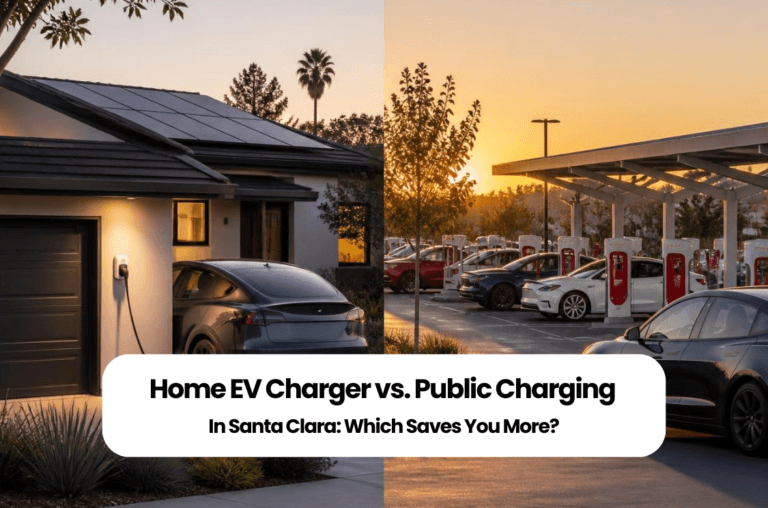
Home Charging vs. Public Charging
| Consideration | Home Charging | Public Charging |
| Convenience | High for homeowners with dedicated parking | Depends on station location |
| Typical use | Daily charging | Trips and occasional top-ups |
| Charging schedule | Usually overnight or when parked | During a dedicated charging stop |
| Installation | Requires suitable electrical infrastructure | No home installation required |
| Upfront equipment | Charger and possible electrical work | Generally no home equipment |
| Best suited for | Regular daily driving | Travel and drivers without home charging |
The two options are not mutually exclusive.
Many EV owners use home charging as their primary method and public charging when circumstances require it.
What Should You Consider Before Installing an EV Charger?
A charger should be selected based on the complete situation rather than simply choosing the highest-powered model available.
The first consideration is your vehicle. Different EVs have different onboard charging capabilities, so installing a charger with a higher maximum output doesn’t necessarily mean the vehicle will charge at that maximum rate.
The second consideration is your electrical system. Your home’s panel and service need to be evaluated to determine whether the planned equipment can be supported safely.
The third consideration is where the charger will be installed. The distance between the electrical panel and parking location can affect installation complexity, wiring requirements, and project cost.
Finally, consider plans. If you expect to add another EV, solar panels, battery storage, or other major electrical loads, discussing those plans with your electrician before installation can help create a more practical long-term solution.
The Up-to-$3,500 MyFirstEV Incentive Is Only One Part of the Ownership Decision
The new MyFirstEV incentive can reduce the upfront cost of an eligible vehicle, but Bay Area homeowners should look beyond the dealership transaction when calculating the overall EV ownership experience.
The vehicle itself is only one component.
There may also be costs associated with charging equipment, electrical work, electricity consumption, insurance, maintenance, and other ownership expenses.
For homeowners, the bigger opportunity is to consider how transportation and household energy are becoming increasingly connected.
An EV can become part of a home energy system that includes solar generation, battery storage, and electrical infrastructure. Whether those technologies make sense depends on the individual property and the homeowner’s goals.
That’s why the smartest approach is usually to evaluate the home before purchasing major charging equipment, rather than choosing equipment first and determining compatibility afterward.
Can Solar Charge an EV During a Power Outage?
Not necessarily.
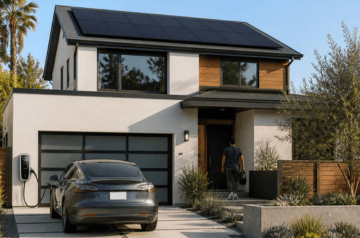
A common misconception is that a home with solar panels will automatically continue charging an EV whenever the grid goes down. In reality, backup operation depends on the system architecture, equipment configuration, electrical design, and whether the EV charger is included within the backed-up electrical loads.
Some solar systems are designed to shut down when the grid goes offline unless they have appropriate backup equipment. Battery systems can provide backup functionality when properly configured, but the amount of power and energy available is limited.
EV charging can also represent a substantial load compared with many essential household circuits.
For that reason, homeowners interested in charging an EV during outages should discuss this requirement before the solar, battery, and electrical system are designed or modified.
Should You Install Solar Before Buying an EV?
There is no universal answer.
If you already own an EV or know that an EV purchase is likely in the near future, including expected EV charging in a solar evaluation can provide a more realistic picture of future electricity consumption.
On the other hand, homeowners who are not ready for an EV don’t necessarily need to install a larger solar system simply because they might purchase one someday.
The important point is to avoid designing today’s system without considering major changes that are reasonably foreseeable.
For example, if a homeowner is currently using a gasoline vehicle but expects to purchase an EV within the next year, telling the solar designer about that plan can help ensure the projected energy consumption is not based solely on historical utility usage.
What If You Already Have Solar and Are Buying an EV?
This is a different situation from installing everything at once.
If your solar system is already operating, you can review your historical electricity production and consumption before deciding how to approach EV charging.
Your actual energy data can help answer questions such as:
- How much electricity does the home currently use?
- How much solar electricity does the system produce?
- When does the home consume the most electricity?
- How much additional electricity might EV charging require?
- Is the existing electrical panel suitable for the planned charger?
- Would future battery storage or additional electrical loads change the plan?
This approach is generally more useful than assuming that a specific charger or solar system will work simply because it works for another homeowner.
How Much Should Bay Area EV Owners Budget Beyond the Vehicle?
The $3,500 MyFirstEV incentive can make an eligible vehicle more affordable, but it shouldn’t be treated as the total financial picture of EV ownership.
A homeowner should consider the complete transition.
| Potential Expense | What to Consider |
| EV purchase or lease | Vehicle price after applicable incentive |
| Home charger | Equipment type and charging capability |
| Electrical installation | Wiring, breaker, labor, and installation distance |
| Panel upgrade | Only if required or appropriate |
| Electricity | Depends on driving and charging habits |
| Solar | Optional; depends on energy goals and existing system |
| Battery storage | Optional; depends on backup and energy-management goals |
| Public charging | Useful for travel and occasional charging |
Not every homeowner will have every expense in this table.
For example, someone with a suitable electrical panel may only need the charger and installation. Another homeowner may need electrical work before installing the charger. Someone who already has solar may have a different energy profile from a homeowner starting from scratch.
The purpose of evaluating these factors is not to make EV ownership appear complicated. It is to avoid unexpected costs and make decisions based on the actual home.
Bay Area EV Charging and Home Electrification
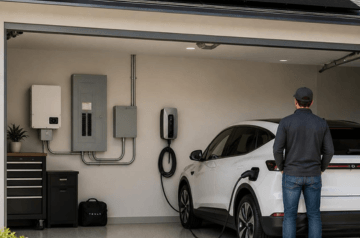
The Bay Area is a particularly interesting market for home electrification because homeowners often combine multiple technologies.
A homeowner may already have rooftop solar and then purchase an EV. Another may be planning a battery installation and considering a charger at the same time. Others may be replacing gas appliances with electric alternatives.
These decisions can overlap.
For example, a homeowner in Fremont, Milpitas, Santa Clara, San Jose, Sunnyvale, or Cupertino may have several major electrical projects planned over the next few years.
Instead of treating each project independently, homeowners can ask a broader question:
What will my home’s electrical system need to support over the next 5–10 years?
That question can lead to better planning than simply asking which EV charger is cheapest today.
Does the MyFirstEV Rebate Make Buying an EV More Affordable?
For an eligible first-time ZEV buyer, a $3,500 incentive can meaningfully reduce the upfront vehicle purchase or lease cost.
But the actual value to an individual household depends on whether the buyer meets the program requirements and selects an eligible vehicle.
It is also important to remember that the rebate should not be treated as a reason by itself to purchase an EV.
A vehicle should still fit the homeowner’s driving requirements, parking situation, charging access, budget, and lifestyle.
For someone who already has convenient home charging and drives regularly, an EV may fit naturally into their daily routine. For someone without dedicated parking or reliable charging access, the decision may require more planning.
The incentive can improve the economics of an eligible purchase, but it doesn’t eliminate the need to evaluate the practical side of EV ownership.
A Practical Checklist for First-Time Bay Area EV Buyers
Before taking advantage of the new California EV incentive, homeowners can work through a few basic questions.
First, confirm the incentive – Check that you meet the current MyFirstEV requirements and that the vehicle and transaction qualify.
Second, think about where you will charge – If you have a dedicated parking space, determine whether home charging is practical.
Third, evaluate your electrical system – Don’t assume your existing panel can support a Level 2 charger simply because the home has electricity available.
Fourth, consider your future energy plans – If solar, battery storage, a second EV, or other electrification projects are likely, mention them during the electrical evaluation.
Finally, compare the complete ownership picture – The vehicle incentive is only one component of the cost and convenience equation.
Should You Install an EV Charger Before Your New EV Arrives?
If you’re purchasing an EV and plan to charge primarily at home, completing the charger installation before the vehicle arrives can make the transition much easier.
Instead of purchasing the vehicle first and then discovering that electrical work is required, homeowners can evaluate the charging location and electrical capacity beforehand.
This can be especially useful if the charger will be installed in a garage that is far from the main electrical panel, if trenching or conduit work may be required, or if the electrical system needs modification.
Planning also allows homeowners to consider whether solar or battery storage should be part of a longer-term home energy strategy.
You don’t necessarily need to install every technology at once.
The objective is simply to avoid making today’s installation incompatible with tomorrow’s plans.
Schedule a No-Obligation Bay Area EV Charging & Solar Assessment
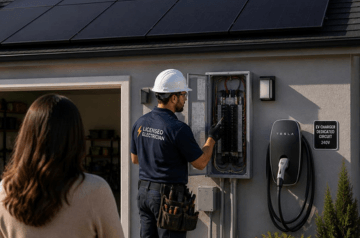
If you’re purchasing your first EV and aren’t sure whether your home is ready for Level 2 charging, a professional electrical assessment can provide a clearer starting point.
Nabu Energy can evaluate your electrical panel, available capacity, charger location, and future energy goals to help determine an appropriate charging approach.
For homeowners considering multiple upgrades, the assessment can also help identify how EV charging, solar panels, battery storage, and electrical infrastructure could fit together over time.
Schedule a no-obligation EV charging assessment with Nabu Energy. An EV charging assessment can help you understand your home’s electrical capacity, charging requirements, and potential future energy needs. Nabu Energy can help homeowners evaluate these considerations and understand available charging options without commission-based sales pressure.
The goal isn’t to sell you the most equipment.
It’s to help you understand what your home actually needs.
⭐⭐⭐⭐⭐ Technical Expertise Without the Sales Pressure
“I am very happy selecting Nabu Energy for my solar project. Keith was very helpful explaining the entire process and taking the time to help educate me with the entire process. They were helpful with me understanding my bill and making sure we have long-term savings with my bill.”
– Verified Bay Area, Homeowner
Frequently Asked Questions
What is California’s new $3,500 EV rebate?
California’s MyFirstEV program provides up to $3,500 toward a qualifying new zero-emission vehicle for eligible first-time ZEV buyers. A separate incentive of up to $1,750 is available for qualifying used ZEV purchases through eligible participating manufacturer programs.
Does the $3,500 rebate cover a home EV charger?
No. The MyFirstEV incentive is a vehicle incentive. It does not automatically cover a Level 2 home charger, charger installation, electrical panel upgrade, solar panels, or battery storage.
Does the EV rebate cover solar panels or battery storage?
No. Solar and battery storage are separate home-energy investments. Homeowners considering these technologies should evaluate them based on electricity consumption, solar production, backup requirements, utility rates, and long-term energy goals.
Do I need a Level 2 charger at home?
Not necessarily. A standard household outlet can charge an EV more slowly, while a Level 2 charger can provide substantially faster charging. The right option depends on your daily driving, parking situation, vehicle, and electrical system.
Can my existing electrical panel support an EV charger?
It may. A professional electrical evaluation can determine whether your existing electrical system has sufficient capacity for the planned charger and whether an upgrade or alternative solution should be considered.
Can solar panels charge an EV?
Yes. Solar electricity can contribute to household electricity consumption, including EV charging. The actual relationship depends on solar production, charging schedules, household loads, utility rates, and system configuration.
Can a home battery charge my EV during a power outage?
Not automatically. Backup EV charging depends on the solar and battery system design, available battery power and energy capacity, electrical configuration, and whether the EV charger is included among the backed-up loads.
Should I install solar and an EV charger at the same time?
Not necessarily. However, if you know you’re planning both, discussing them together can help ensure future electricity consumption and electrical capacity are considered during system planning.
Is the $3,500 incentive enough to make an EV worthwhile?
The incentive can reduce the upfront cost for an eligible buyer, but whether an EV makes sense depends on the vehicle, driving habits, charging access, electricity costs, and overall ownership expenses.
Key Takeaways
California’s MyFirstEV incentive may make the transition to a qualifying zero-emission vehicle (ZEV) more attractive for eligible first-time buyers to reduce the upfront cost of purchasing or leasing an electric vehicle. But the vehicle incentive is only one part of the transition to electric transportation.
For Bay Area homeowners, the bigger question is how an EV will fit into the home.
Home charging, electrical capacity, solar generation, battery storage, and future electrification plans can all influence the long-term experience.
The best approach is to evaluate the home before purchasing major electrical equipment and to consider today’s needs alongside realistic plans.
A $3,500 vehicle incentive can help you get into an EV. Good electrical and energy planning can help make owning it easier.
Why Nabu Energy Takes a Whole-Home Approach
Choosing an EV is a vehicle decision, but preparing a home for an EV can involve much more than selecting a charger.
Nabu Energy approaches residential electrification by looking at the home’s electrical infrastructure, current energy consumption, and plans together.
For homeowners in the Bay Area, that can include evaluating the relationship between:
EV Charger → Electrical Panel → Solar → Battery Storage → Future Electrical Loads
The goal is not to recommend every technology for every homeowner. Instead, the objective is to determine what makes sense for the property and the homeowner’s actual needs.
Nabu Energy provides residential electrical and energy solutions including EV charger installation, electrical panel upgrades, residential solar, and battery storage.
If you’re considering several of these upgrades, discussing them together can help avoid designing one system today that creates unnecessary limitations for a future project.
What to Do Before Claiming an EV Rebate
Before moving forward with an eligible EV purchase or lease, take the time to verify the current electric car rebate requirements directly with the appropriate program or participating manufacturer.
EV incentives can have different requirements, including vehicle eligibility, income requirements, purchase or lease conditions, and available funding.
When comparing car incentives, don’t let the available incentive become the only factor determining which vehicle you purchase
A practical approach is to separate the process into two decisions:
Decision 1: Does the EV Make Sense for You?
Consider your:
- Daily driving distance
- Vehicle requirements
- Parking situation
- Access to home or workplace charging.
- Expected ownership period
- Total vehicle cost
Decision 2: Is Your Home Ready for the EV?
Consider:
- Existing electrical panel
- Available electrical capacity
- Charger location
- Wiring requirements
- Future EV plans
- Solar plans
- Battery storage plans
- Other planned electrical loads
Keeping these decisions separate helps prevent the $3,500 incentive from becoming the only factor driving the purchase.
Final Takeaway: Start With the Vehicle, Plan for the Home
California’s new electric vehicle incentives can make the transition to electric transportation more attractive for qualifying first-time ZEV buyers.
But getting the most value from an EV isn’t simply about understanding electric car incentives.
For Bay Area homeowners, the next question should be:
“How will this EV fit into my home’s electrical and energy system?”
If you have dedicated parking, overnight home charging may become the most convenient part of EV ownership. If your electrical panel has limited capacity, an evaluation can help identify the appropriate next step. And if you’re considering solar or battery storage, incorporating those plans into the conversation can help create a more coordinated long-term strategy.
You don’t have to install everything at once.
You simply need to understand how today’s decision could affect tomorrow’s options.
Sources & References
Primary Source: California Energy Commission (CEC) – MyFirstEV incentive information and California zero-emission vehicle sales data.
Additional Sources: U.S. Department of Energy (DOE) – EV charging and charging infrastructure information; PG&E – EV Charging – residential EV programs, charging rates, and home electrification information.
About Nabu Energy
Nabu Energy is a Bay Area residential energy and electrical contractor serving homeowners with solutions designed around their property’s electrical requirements and long-term energy goals.
Our services include:
- Residential EV charger installation
- Electrical panel upgrades
- Residential solar installation
- Battery storage installation
- Electrical evaluations
- Home electrification planning
Our approach is centered on technical evaluation and informed decision-making rather than high-pressure sales. Contact us today.
Last Reviewed: August 2026
Disclaimer
This article is provided for general educational and informational purposes only and is not intended to provide tax, legal, financial, engineering, or electrical advice.
California EV incentive programs, eligibility requirements, vehicle qualifications, funding availability, utility programs, electricity rates, and other policies may change. The MyFirstEV incentive described in this article is administered through California’s applicable clean transportation program framework and is subject to current program requirements.
Nabu Energy does not administer the MyFirstEV program and does not determine a customer’s eligibility for any EV incentive. References to potential incentives should not be interpreted as a guarantee that a particular homeowner, vehicle, purchase, or lease will qualify or receive a specific incentive amount. Homeowners should verify current requirements, eligibility, vehicle qualifications, funding availability, and transaction requirements directly with the applicable program or participating dealer before making a purchase or lease decision.
Electrical requirements vary by property. EV chargers, electrical panels, solar systems, battery storage, and related equipment should be evaluated and installed by appropriately qualified professionals in accordance with applicable requirements.
Any discussion of potential energy savings, costs, or benefits is illustrative only. Actual results vary based on the property, equipment, electricity usage, utility rates, system configuration, charging behavior, and other factors. Nabu Energy does not guarantee savings, energy production, incentive eligibility, or specific financial outcomes.
Information in this article was reviewed as of August 2026. Readers should verify current program requirements and other applicable information before making purchasing, electrical, or energy-related decisions.