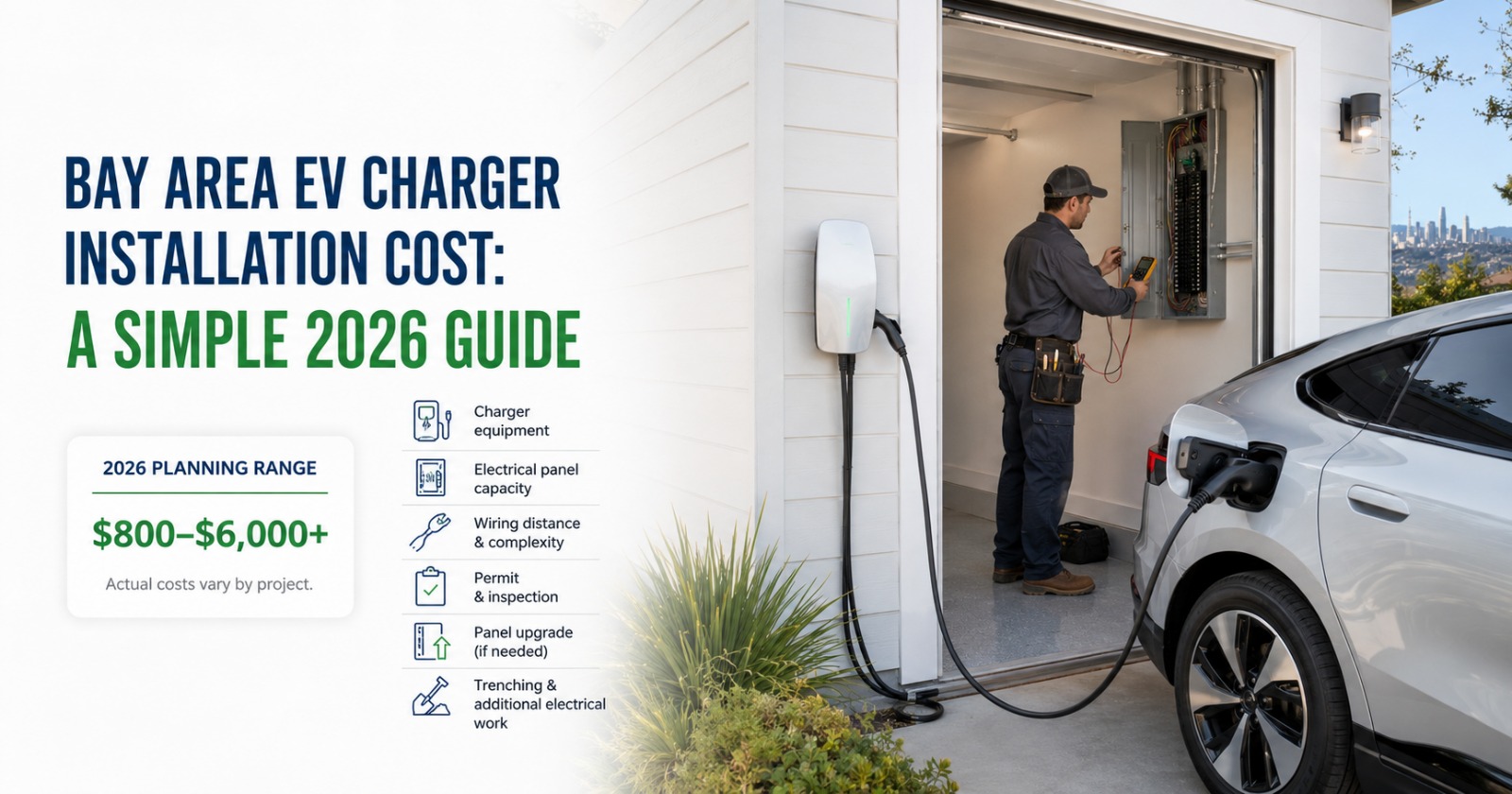
Wondering what EV charger installation costs in the Bay Area? For most homeowners, a professionally installed Level 2 home charger falls somewhere between $1,500 and $3,000. Simpler garage installations can start closer to $800, while more involved projects — a panel upgrade, trenching, or utility service work — can reach $6,000 or more. The price depends far more on your home’s existing electrical setup than on the charger itself.
This guide breaks down what goes into EV charger installation cost in the Bay Area, what makes the price go up, which rebates and credits apply in 2026, and how to get an accurate quote for your specific home.
What this guide covers
How much does EV charger installation cost in the Bay Area?
For budgeting purposes, these are reasonable EV charger installation cost ranges for Bay Area homes in 2026. Actual pricing varies by home, electrical capacity, wiring distance, equipment, permitting, and site conditions.
| Project type | 2026 planning range |
|---|---|
| Simple garage installation | ~$800–$1,500+ |
| Typical Level 2 installation | ~$1,500–$3,000+ |
| Longer wiring / additional electrical work | ~$3,000–$6,000+ |
| Major electrical upgrade, trenching or service work | $6,000+ |
These are planning estimates, not fixed Nabu Energy prices. Your actual EV charger installation cost depends on the charger, electrical panel capacity, wiring distance, installation location, permitting, trenching, and any required electrical upgrades.
The single biggest variable is usually whether your home’s electrical panel can support a new 240-volt circuit. If it can, your project tends to sit toward the lower end of these ranges. If a panel upgrade is required, it moves toward the higher end.
What’s included in your EV charger installation cost
EV charger installation cost in the Bay Area is really three costs bundled together: the equipment, the labor, and the permit.
The charger (EVSE)
The charging unit itself is usually a smaller share of the total than most people expect.
- Basic Level 2 charger: roughly $300–$700
- Smart/Wi-Fi Level 2 charger: roughly $500–$1,200+
Equipment pricing varies by charger brand, power level, features, and whether the charger is included in the installation quote.
A smart charger is often worth considering in the Bay Area, because it lets you schedule charging for off-peak hours and align with PG&E’s time-of-use EV rates. Many smart chargers also support load management, which can matter if your panel is tight on capacity.
Labor and installation
Electrician labor rates vary by contractor and project complexity. Installation labor may range from several hundred dollars for a straightforward installation to $1,000 or more for longer or more complex runs.
What typically drives labor up: the length of the wiring run, whether the route passes through finished walls, an attic, or a crawl space, the mounting location, and any additional work needed at the panel.
Permits and inspection
Permit requirements and fees vary by city and project. Many Bay Area jurisdictions require an electrical permit for a Level 2 EV charger installation, but homeowners should confirm the current requirements with their local building department or installer.
Where a permit applies, inspection is part of the process — it confirms the circuit, breaker, conductors, and mounting meet current electrical code. Some cities now offer streamlined or online permitting for residential EV charging, which can shorten the timeline.
What makes Bay Area EV charger installation cost more?
If your EV charger installation cost is higher than you expected, it usually comes down to one of these factors.
Distance from the electrical panel
The farther your charger is from your main panel, the more wire, conduit, and labor are needed. A charger on the opposite side of the house — or in a detached garage — costs meaningfully more than one mounted a few feet from the panel.
Electrical panel upgrades
This is the big one. Many older Bay Area homes have 100-amp service that’s already close to capacity, and adding a 40- or 50-amp EV circuit may require upgrading to a 200-amp panel. A main electrical panel upgrade can add roughly $1,500–$4,000 or more, depending on the equipment, service requirements, utility work, and project complexity.
Trenching and outdoor runs
If power has to be routed underground — to a detached garage, carport, or driveway — trenching and underground conduit can add roughly $500–$1,500 or more, depending on distance, surface type, depth, access, and restoration requirements.
Do you need an electrical panel upgrade?
Not always. A licensed electrician will check your panel’s available capacity and breaker space. In many cases, a load calculation shows there’s enough headroom, or a smart charger with load management can share existing capacity without a full upgrade — which can save a significant amount.
This is exactly why a real site assessment matters more than an online estimate: two similar homes on the same street can have very different EV charger installation costs depending on their panels.
Level 1 vs. Level 2 charging: which is worth the cost?
Level 1 charging (a standard 120-volt outlet) costs almost nothing to set up but typically adds only 3–5 miles of range per hour — often not enough for Bay Area commutes. Level 2 charging (240 volts) typically adds 20–40 miles per hour and recharges most EVs overnight. For nearly every Bay Area household, Level 2 is the setup worth paying for, and it’s what this EV charger installation cost guide covers.
EV charger rebates and tax credits in the Bay Area (2026)
Incentives change often, so here’s where things stand in 2026:
- Federal 30C tax credit: The federal Alternative Fuel Vehicle Refueling Property Credit provided eligible homeowners a credit of 30% of qualifying costs, up to $1,000 per item, subject to eligibility requirements including location in a qualifying census tract. The credit applies to qualifying property placed in service through June 30, 2026; property placed in service after June 30, 2026 does not qualify under the expired provision.
- PG&E Residential EV Charging rebate: Eligible PG&E residential customers may qualify for rebates on approved EV charging equipment. Standard applicants may qualify for up to 50% of the purchase price of eligible equipment, while qualifying income-based applicants may be eligible for larger rebates, including up to $2,000 for charger installation or up to $5,000 for a qualifying panel upgrade and charger installation. Eligibility, equipment requirements, funding availability, and program terms apply and can change.
- The $3,500 MyFirstEV rebate is separate. That’s a vehicle incentive, not a charger rebate — but if you’re buying an EV, it’s worth understanding alongside your home setup. We cover it in detail in our guide to California’s $3,500 EV rebate for Bay Area drivers.
Because these programs shift, the most reliable way to know what you qualify for is to have an installer confirm current incentives as part of your quote.
How to lower your EV charger installation cost
A few practical ways Bay Area homeowners keep EV charger installation cost down:
- Mount the charger near your panel where possible — it’s the easiest way to reduce labor and materials.
- Consider a smart charger with load management, which may allow you to avoid a panel upgrade.
- Plan related work together. If you’re already considering solar, battery storage, or a panel upgrade, planning them alongside EV charging can sometimes reduce duplicated labor, permitting, and electrical work, depending on the project.
- Get a proper load calculation before assuming a full panel upgrade is required — in many homes, it isn’t.
Why solar and battery change the EV charging equation
An EV can significantly increase a home’s electricity use, depending on how much the vehicle is driven and how efficiently it charges. For many Bay Area homeowners, that added consumption makes solar, battery storage, and EV charging planning worth considering together.
That’s why many households pair EV charging with home solar and battery storage: solar can offset part of the added charging load, and a battery can keep essential loads running during an outage. Planning EV charging alongside solar, battery storage, or a panel upgrade can sometimes reduce duplicated labor, permitting, and electrical work, depending on the project.
How to get an accurate EV charger installation cost quote
An online calculator can’t see your electrical panel. The only way to know your real EV charger installation cost is a site assessment where a licensed electrician checks your panel capacity, measures the wiring run, and confirms current permit requirements and available rebates for your city.
Nabu Energy installs EV chargers, home solar, battery storage, and electrical panel upgrades across San Jose, Santa Clara, Sunnyvale, Milpitas, Cupertino, Mountain View, Fremont, and the wider Bay Area — with zero sales commission and honest, no-pressure guidance.
Frequently Asked Questions
How much does it cost to install an EV charger in the Bay Area?
As a planning range, most Bay Area homeowners can expect roughly $1,500 to $3,000 for a professionally installed Level 2 charger. Simple garage installations can start closer to $800, while projects involving a panel upgrade, trenching, or service work can reach $6,000 or more. Your actual EV charger installation cost depends on your home’s electrical capacity, wiring distance, equipment, and permitting.
Why is EV charger installation more expensive in the Bay Area?
Regional labor rates, local permitting requirements, and an older housing stock — where many homes still have 100-amp service with limited spare capacity — all tend to push Bay Area EV charger installation cost above national averages.
Do I need a permit to install an EV charger in the Bay Area?
Usually, yes. Many Bay Area jurisdictions require an electrical permit for a hard-wired 240-volt Level 2 charger, but requirements and fees vary by city. Confirm the current process with your local building department or your installer before work begins.
Will installing an EV charger require a panel upgrade?
Not always. It depends on your panel’s available capacity. Many homes have enough headroom, and smart chargers with load management can sometimes avoid an upgrade. A licensed electrician confirms this with a load calculation.
How long does EV charger installation take?
A straightforward installation often takes a few hours. Jobs involving a panel upgrade, long wiring runs, or trenching can take a full day or more, plus scheduling time for permitting and inspection.
Is there still a tax credit for home EV chargers in 2026?
The federal 30C credit applies to qualifying property placed in service through June 30, 2026; property placed in service after that date does not qualify under the expired provision. Separately, eligible PG&E residential customers may qualify for EV charging equipment rebates, subject to program terms and funding availability.
Is a Level 2 charger worth the extra cost?
For most Bay Area drivers, yes — the extra EV charger installation cost pays off quickly. Level 2 charging typically adds 20–40 miles of range per hour and recharges most EVs overnight, versus roughly 3–5 miles per hour on a standard 120-volt outlet.
Why choose Nabu Energy for EV charger installation in the Bay Area
Nabu Energy is a Bay Area-based installer specializing in EV chargers, solar, battery storage, and panel upgrades. We work on a zero-commission model, so our recommendations are about what your home actually needs — not an upsell. Every EV charger installation cost quote starts with a real assessment of your panel and wiring, a clear line-item price, and a straight answer on what a project will and won’t cost.