Should You Install Battery Storage Now, Later, or Not at All?
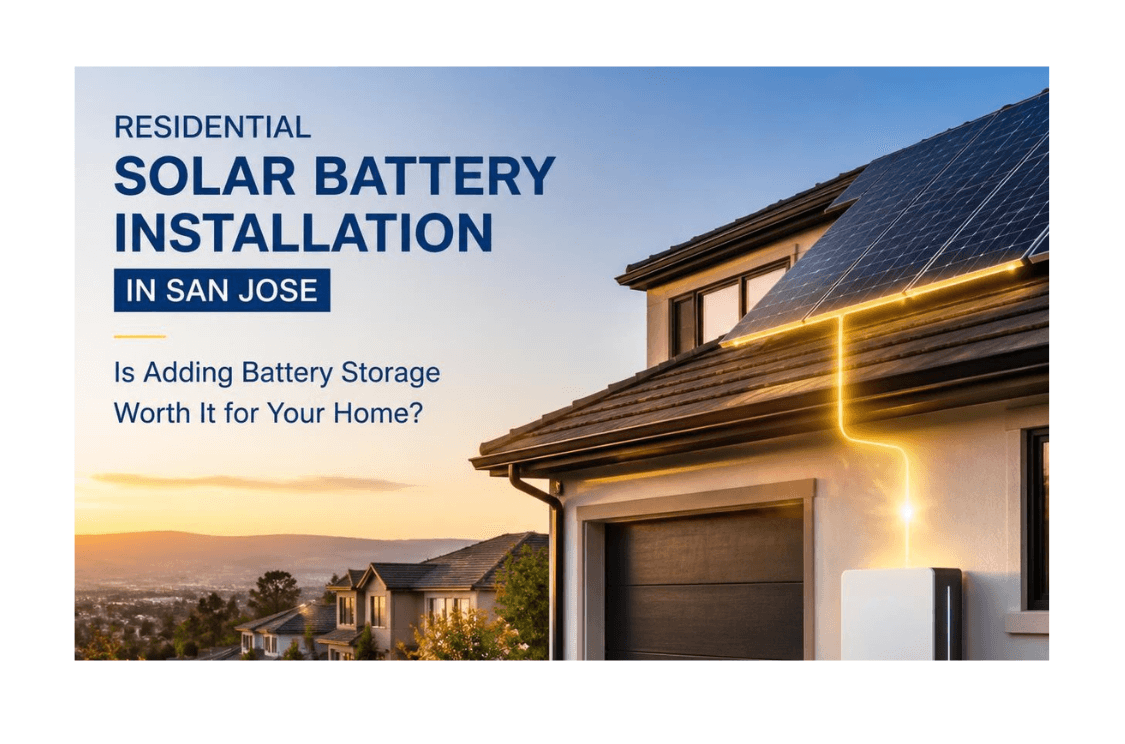
For many homeowners in San Jose, installing solar panels is no longer the only energy decision to make. A growing number of homeowners are also considering battery storage but an important question remains: Is adding battery storage worth it for your home?
The answer isn’t the same for every property. Some homes benefit from installing battery storage alongside a new solar system, while others may choose to add a battery years after their solar installation. In some situations, homeowners may even decide that battery storage isn’t necessary right now. The right decision depends on your home’s electrical system, energy usage, backup power priorities, existing solar equipment, and long-term plans.
Why More San Jose Homeowners Are Considering Battery Storage
San Jose is home to a diverse mix of neighborhoods, ranging from established communities with older electrical infrastructure to newer developments designed for modern energy needs. Many homes are served by PG&E, where homeowners have experienced Public Safety Power Shutoff (PSPS) events, changing electricity rates, and increasing household electricity demand.
At the same time, more families are adding electric vehicles, home offices, heat pumps, induction cooking, and other electric appliances that increase overall energy consumption. These changes are prompting many homeowners to evaluate whether battery storage should become part of their long-term home energy strategy.
When Battery Storage May Be Worth Considering
Battery storage is not simply about having backup power. For many homeowners, it becomes part of a broader residential energy plan.
You may wish to explore battery storage if you:
- Already have solar panels and want to store available solar energy for later use.
- Are installing a new residential solar system and want to plan for future energy needs.
- Want selected household circuits to remain operational during qualifying utility outages.
- Are preparing for future home electrification projects such as EV charging or electric heating.
- Prefer evaluating solar and battery storage together instead of making separate upgrades later.
Every home’s requirements are different, which is why a professional evaluation is important before selecting equipment.
When Battery Storage May Not Be the Right Choice – Yet
Battery storage is not automatically the best solution for every homeowner.
Some homeowners may decide to postpone battery installation if:
- Their household electricity usage is relatively low.
- Backup power is not a current priority.
- They are planning a future home renovation that may affect electrical equipment.
- They intend to expand or replace their solar system later.
- They prefer to phase home energy improvements over time.
Understanding when battery storage may not be necessary is just as important as understanding when it can provide value. Comparing different options allows homeowners to make informed decisions based on their own circumstances rather than following a one-size-fits-all recommendation.
What Do You Want to Keep Running During a Power Outage?
One of the first questions homeowners should ask is not, “How many batteries do I need?” but rather, “What do I want my battery to power?”
Some homeowners choose to back up only essential circuits, while others prefer broader household coverage. Common priorities include:
- Refrigerators and freezers
- Internet and Wi-Fi equipment
- Interior lighting
- Garage door openers
- Medical equipment
- Selected kitchen appliances
- Home office equipment
The circuits selected for backup influence system design, battery capacity, and the overall installation approach.
Can You Add Battery Storage to an Existing Solar System?
Yes. In many cases, battery storage can be added to an existing residential solar system.
Compatibility depends on several factors, including:
- Existing inverter configuration
- Solar equipment already installed
- Electrical service capacity
- Available installation space
- Local permitting requirements
Many San Jose homeowners installed solar panels several years ago and are now exploring battery storage as the next step in upgrading their home’s energy system. A professional evaluation helps determine which battery technologies are compatible with the existing installation.
Older San Jose Homes May Require Additional Electrical Planning
San Jose’s housing stock spans many decades, and electrical infrastructure can vary significantly from one neighborhood to another. Homes in areas such as Willow Glen, Rose Garden, Alum Rock, and Cambrian Park may have different electrical panel configurations than newer homes in North San Jose or Evergreen.
Before battery storage is installed, some homes may require electrical improvements to support new equipment safely and in accordance with applicable codes. Evaluating the home’s electrical service early in the planning process helps identify any upgrades that may be needed before installation begins.
Choosing the Right Battery Size for Your Home
There is no standard battery size that works for every property.
The appropriate battery configuration depends on factors such as:
- Daily electricity consumption
- Number of occupants
- Existing solar production
- Electric vehicle charging
- Air conditioning usage
- Backup power priorities
- Future home electrification plans
Rather than selecting the largest available battery, homeowners should choose a system designed around their actual energy requirements and long-term objectives.
Planning for Tomorrow’s Energy Needs
Battery storage should not be viewed only as today’s purchase, it should also support tomorrow’s home.
Many San Jose homeowners are gradually transitioning to electric transportation and electric appliances. Future additions such as EV chargers, heat pumps, induction cooktops, electric water heaters, or expanded home offices may increase household electricity demand over time.
Considering these future plans during the design process may help homeowners select a battery system that continues to support their needs as their home evolves.
Why Customized System Design Matters
Every home’s electrical system is different. Battery storage performs best when it is designed around the property’s electrical configuration, energy usage, backup priorities, and future plans rather than applying the same solution to every installation.
Nabu Energy completes both system design and installation using its in-house teams. The company performs detailed electrical evaluations to understand each home’s existing electrical infrastructure, particularly for older homes where electrical upgrades may be required before battery installation.
Rather than recommending a single manufacturer for every project, Nabu Energy follows a manufacturer-agnostic approach and specializes in residential battery storage systems from Tesla, Enphase, and SolarEdge. Recommendations are based on compatibility with the home’s electrical system, existing or planned solar installation, and the homeowner’s long-term objectives.
Nabu Energy also follows a Zero Sales Commission business model, allowing system recommendations to focus on technical suitability, customized backup planning, and homeowner requirements rather than individual sales incentives.
Frequently Asked Questions
Is battery storage worth the investment?
It depends on the home’s energy goals, existing solar system, backup power priorities, electrical configuration, and future plans. Battery storage may be appropriate for some homeowners, while others may choose to install it later or determine that it is not currently necessary.
Can my air conditioner run on battery backup?
Some battery systems can support air conditioning, while others are designed to power only selected household circuits. Whether an air conditioner can operate on battery backup depends on the battery capacity, system design, electrical configuration, and the home’s overall energy demand.
How long can a battery power essential household loads?
Backup duration varies depending on battery capacity, household electricity usage, the number of circuits being powered, and the overall system configuration. Two homes using the same battery may experience different backup times because their energy consumption differs.
Can battery storage be added years after installing solar panels?
In many cases, yes. Existing solar systems can often be upgraded with battery storage. Compatibility depends on the existing equipment, inverter configuration, electrical service, available installation space, and applicable permitting requirements.
What electrical upgrades might be required before installing a battery?
Some homes may require electrical panel upgrades or other electrical improvements before battery storage can be installed. The need for upgrades depends on the home’s existing electrical service, equipment capacity, and applicable electrical codes. A professional evaluation helps determine whether upgrades are necessary.
Why Homeowners Choose Nabu Energy
Nabu Energy is a licensed California electrical contractor specializing in residential solar, battery storage systems, electrical upgrades, and EV charging solutions throughout San Jose and the Bay Area. The company completes both system design and installation using its in-house teams, specializes in customized backup planning, and follows a Zero Sales Commission business model that focuses on each homeowner’s technical requirements and long-term energy goals.
Nabu Energy specializes in battery storage solutions from Tesla, Enphase, and SolarEdge, allowing homeowners to evaluate multiple technologies based on compatibility with their home’s electrical configuration rather than promoting a single battery brand. Nabu Energy is also a Tesla Powerwall 3 Certified Installer, while continuing to provide manufacturer-agnostic recommendations tailored to each project.
Disclaimer
This article is provided for general informational purposes only and should not be considered legal, financial, tax, or engineering advice. Battery storage system performance, installation costs, available equipment, permitting requirements, utility programs, installation timelines, and code requirements vary by property, utility provider, manufacturer, and local jurisdiction. Homeowners should obtain multiple written proposals, verify contractor licensing, review all contract terms carefully, and consult a licensed California contractor before making any purchasing decision.